

Building resilient agricultural supply chains requires shared responsibility. BioFinCas brings together producers, companies, financial institutions and other value-chain actors to share risks, strengthen resilience and create the conditions for biodiversity-friendly and climate-resilient production.
Agricultural value chains are increasingly expected to manage climate risks, biodiversity impacts and evolving regulatory requirements while maintaining reliable supply. Finding practical ways to share risks and responsibilities across complex value chains can be challenging.
This page provides a clear overview of key approaches to building more resilient and biodiversity-friendly supply chains.
Why Resilience Matters
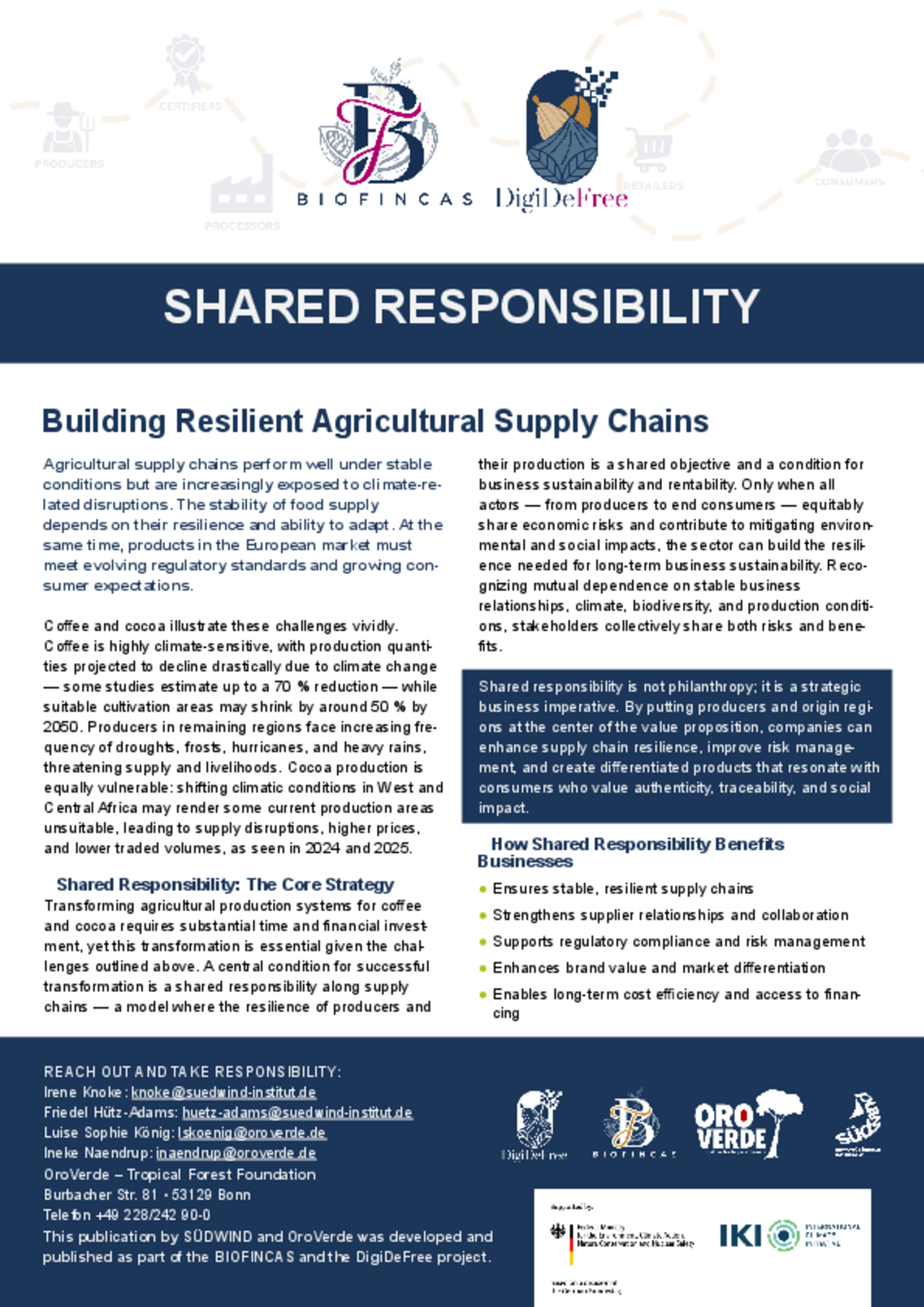
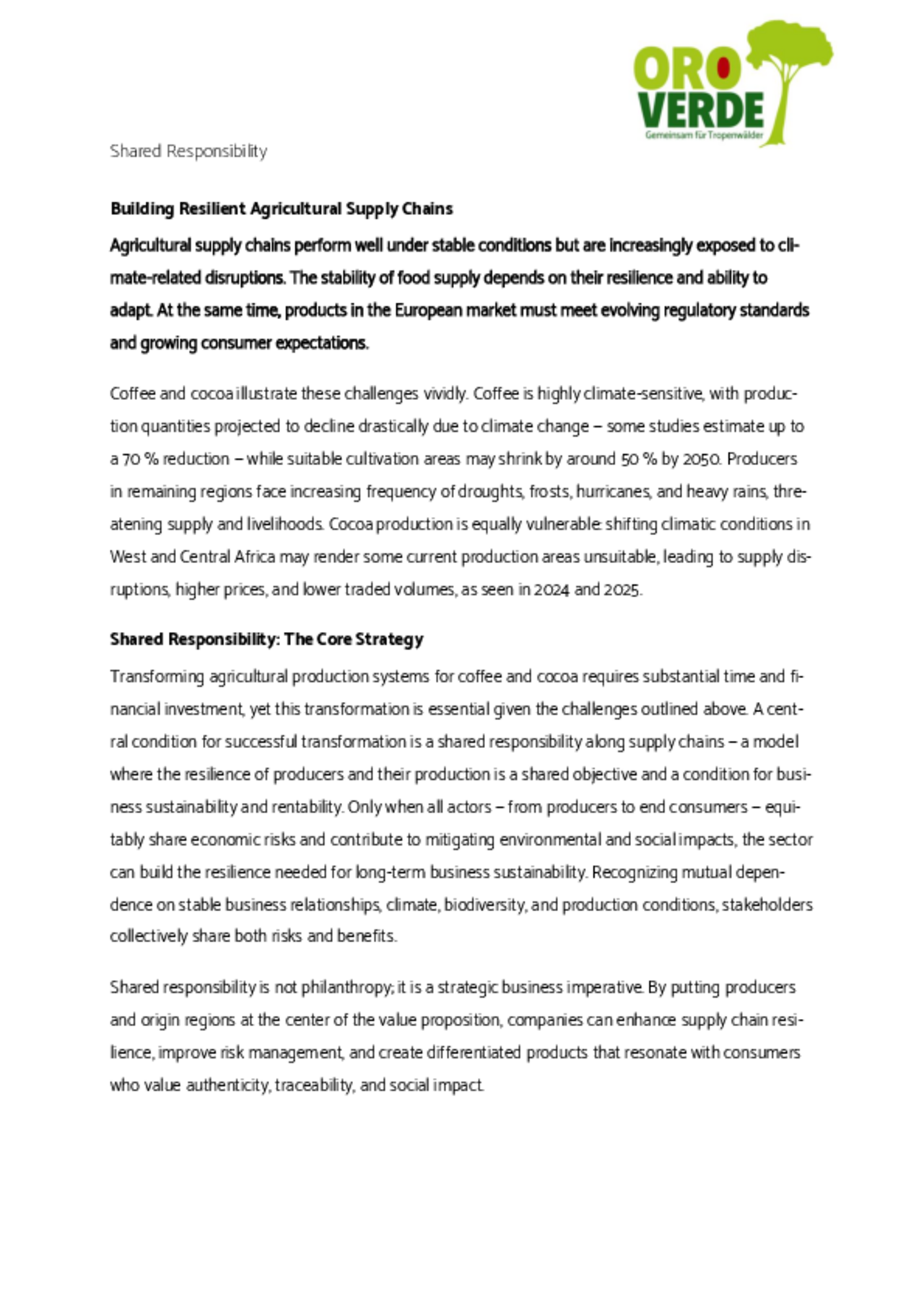
Agricultural supply chains perform well under stable conditions but are increasingly exposed to climate-related disruptions. This holds especially true for goods produced in tropical forest areas, where climate change impacts are already destabilizing production. The stability of food supply depends highly on their resilience and ability to adapt. At the same time, products in the European market must meet evolving regulatory standards and growing consumer expectations. Transforming agricultural production systems in line with the changing environment, for example for coffee and cocoa, requires substantial time and financial investment, yet is essential given the challenges outlined above.
From Shared Risks to Shared Responsibility
A central condition for successful transformation is a shared responsibility along supply chains — a model where the resilience of producers and their production is a shared objective and a condition for business sustainability and rentability. Only when all actors — from producers to end consumers — equitably share economic risks and contribute to mitigating environmental and social impacts, the sector can build the resilience needed for long-term business sustainability. Recognizing mutual dependence on stable business relationships, climate, biodiversity, and production conditions, stakeholders collectively share both risks and benefits.
The Three Pillars of Shared Responsibility
Building resilient supply chains against climate change and extreme weather events requires targeted actions in three areas:
Integrating biodiversity protection, forest conservation, and climate-adapted practices in agricultural production stabilizes essential ecosystem services—soil fertility, pollination, water regulation, and pest control—while buffering against climate shocks. Forests regulate local and global climates and prevent erosion, safeguarding productive farmland. Collective commitment to biodiversity-friendly landscapes strengthens resilience across the value chain.
Secure, fair incomes enable producers and workers to invest in sustainable practices, education, and farm improvements, enhancing productivity and supply reliability. Promoting income stability and gender equity is both a social responsibility and a strategic imperative, reducing supply risks and supporting broader climate adaptation and inclusive development goals.
Many producers, particularly smallholders and Indigenous Peoples, face barriers to meeting regulatory requirements (e.g., EUDR, CSRD, CSDDD). Implementing joint due diligence processes, shared data systems, and harmonized reporting formats reduces risk, increases efficiency, and builds trust and transparency across the supply chain.
Further Enablers of Shared Responsibility
Building a true shared responsibility model in agri-food value chains requires coordinated action among companies, their suppliers and producer organizations, often with assistance by technical and financial partners. Two key enablers support the creation and long-term maintenance of such shared responsibility models:
- Long-term Relationships & Transparency
Stable contracts, price guarantees, and traceability systems support investments in sustainable production and ensure reliable supply for processors. Long-term collaboration also facilitates shared due diligence processes. - Financing Strategies: Blended Finance & Co-Investment
Combining public, private, and philanthropic capital enables risk-sharing, expands intervention scope, and facilitates long-term investments that benefit both producers and companies.
Explore shared responsibility in practice
Are you looking for ways to strengthen resilience and share risks across your value chain? Get in touch to discuss your context, exchange perspectives and explore opportunities for collaboration with BioFinCas at COP17 and beyond.
Schedule an initial conversation

Luise König
+49 228 24290-62
lkoenig[at]oroverde[dot]de

Ineke Naendrup
+49 228 24290-78
inaendrup[at]oroverde[dot]de
Image credit: ©OroVerde – Luise Sophie König (Header)
Last edited: 30.09.2026

